The Holy Prophet (s.w.a.) was a virtuous man. He used to engage in trade in the era of jahaliyya...
In the Name of Allah, the Merciful, the Most Merciful
Sura 21: AL-ANBIYA (THE PROPHETS) - Juz' 17 - Translation Qarib
**************
Note: All content is free to use
Martyr Imam Khamenei:
The Supreme Leader’s View of the Holy Prophet (s.w.a.)
The Holy Prophet’s (s.w.a.) leniency and strictness
The Holy Prophet (s.w.a.) has been praised in the Holy Quran because of his
lenient treatment of people. Addressing the Holy Prophet (s.w.a.), Allah the
Exalted says in the Holy Quran, “Thus, it is due to mercy from Allah that you
deal with them gently, and had you been rough and hard-hearted, they would
certainly have dispersed from around you.” [The Holy Quran, 3: 159] Elsewhere in
the Holy Quran, Allah the Exalted tells the Holy Prophet (s.w.a.), “O Prophet,
strive hard against the unbelievers and the hypocrites, and be hard against
them.” [The Holy Quran, 66: 9] Allah the Exalted tells His Messenger to treat
the unbelievers and the hypocrites roughly. The word “hard” has been used in
both ayahs. However, the first ayah is related to the Holy Prophet’s (s.w.a.)
behavior towards other members of his society, while the second ayah is about
enforcing the law, managing society and establishing order. In the first case,
being hard-hearted is bad. But in the second case, being hard-hearted is good.
Being rough is bad in the first case and good in the second…
Martyr Imam Khamenei:
The Supreme Leader’s View of the Holy Prophet (s.w.a.)
Trustworthiness of the Prophet of Islam (s.w.a.)
The Holy Prophet (s.w.a.) was so trustworthy that he was known as Muhammad
al-Amin [Muhammad the Trustworthy] in the jahaliyya pre-Islamic society.
Whenever the people of his society had something which was very valuable to
them, they used to give it to the Holy Prophet (s.w.a.) to hold it in trust, and
they were sure that he would return it to them undamaged. Even after the Holy
Prophet (s.w.a.) started calling people to Islam and hostilities were aroused
with Quraysh, the enemies of Islam still used to leave their valuable belongings
with the Holy Prophet (s.w.a.). When the Holy Prophet (s.w.a.) migrated to
Medina, he left the Commander of the Faithful (a.s.) in Mecca in order to return
what people had left with him. Therefore, it is clear that when the Holy Prophet
(s.w.a.) decided to migrate to Medina, he was still holding certain things in
trust. And these things did not belong to Muslims: they belonged to the
unbelievers and those who were hostile to him…

Martyr Imam Khamenei:
The Supreme Leader’s View of the Holy Prophet (s.w.a.)
Patience of the Holy Prophet (s.w.a.)
The Holy Prophet (s.w.a.) was so patient that he was not disturbed by the kind
of things that made other people impatient. Sometimes the enemies of the Holy
Prophet (s.w.a.) in Mecca used to treat him in a way that when Abi Talib [Holy
Prophet’s (s.w.a.) uncle] heard about one case of such treatment, he got so
angry that he drew his sword, went to those who had treated the Prophet (s.w.a.)
with disrespect and treated them in the same way. He said that he would behead
anybody who protested. But the Holy Prophet (s.w.a.) had tolerated that
treatment with patience. In another case, Abu Jahl insulted the Holy Prophet
(s.w.a.) in a very bad way, but the Holy Prophet (s.w.a.) exercised patience and
remained silent. Somebody went to Hamza and told him that his nephew had been
mistreated. Hamza lost patience and went to Abu Jahl. He banged his bow so hard
on Abu Jahl’s head that blood gushed out from his head. Affected by this event,
Hamza converted to Islam later on. Sometimes some people used to go the mosque
where the Prophet (s.w.a.) was and stretched out their feet, and they used to
tell the Holy Prophet (s.w.a.) to cut their nails. But the Holy Prophet (s.w.a.)
used to tolerate their insolence with patience.
Martyr Imam Khamenei:
The Supreme Leader’s View of the Holy Prophet (s.w.a.)
Calling people to ethical virtues
It is necessary to call people to ethical virtues, namely mercy, leniency,
kindness, patience, steadfastness, controlling one’s anger and avoiding
betrayal, theft, slander, malevolence and ill will. People will always be in
need of these ethical values. It is not possible to imagine a day when people
will not need these values. They will always need these ethical values. A
society in which these values are absent will be a bad and insignificant society
even if it achieves the peak of progress...
Martyr Imam Khamenei:
The Supreme Leader’s View of the Holy Prophet (s.w.a.)
Magnanimity of the Holy Prophet (s.w.a.)
In the jahaliyya pre-Islamic society, the people of Mecca had created an alliance called “Hilf al-Fudul” [Alliance of the Virtuous], and the Holy Prophet (s.w.a.) was a member of this alliance. One day a stranger enters Mecca and sells something that he had brought with him. The person who had bought it was a man called Aas ibn Wail, a burly thug who was among Meccan aristocrats. He had refused to pay the man. The stranger goes to different people, but nobody helps him. Therefore, he climbs to the top of Mount Abu Qubays and shouts, “O children of Fahr, I have been wronged.” The Holy Prophet (s.w.a.) and his uncle Zubayr ibn Abdul Mutallib hear his shout. So they gather in a place and decide to defend his rights. They go to Aas ibn Wail and tell him to pay the man. He is scared and is forced to pay the man. They maintained the alliance and decided to defend non-Meccans whenever they were wronged by the people of Mecca. Usually the people of Mecca used to treat non-Meccans unfairly. Many years after the introduction of Islam, the Holy Prophet (s.w.a.) used to say that he was still committed to the terms of the alliance. He repeatedly treated his defeated enemies in a way that was not understandable to them. In the 8th year of the Hijri calendar, when the Holy Prophet captured Mecca in an impressive way, he said, “Today is the day of mercy.” Therefore, he did not take revenge. This shows the magnanimity of the Holy Prophet (s.w.a.)...
Martyr Imam Khamenei:
The Supreme Leader’s View of the Holy Prophet (s.w.a.)
Honesty of the Holy Prophet (s.w.a.)
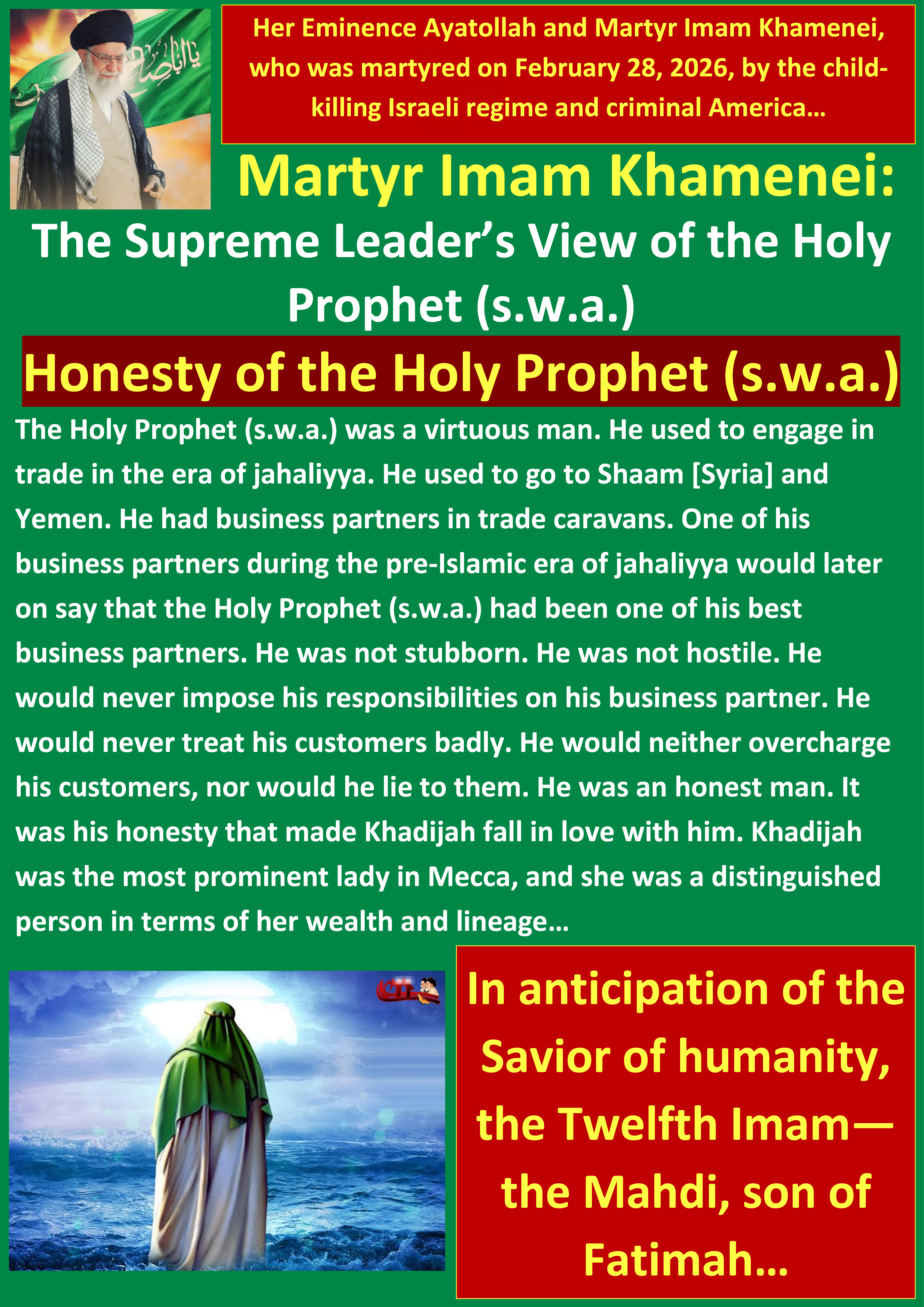
The Holy Prophet (s.w.a.) was a virtuous man. He used to engage in trade in the era of jahaliyya. He used to go to Shaam [Syria] and Yemen. He had business partners in trade caravans. One of his business partners during the pre-Islamic era of jahaliyya would later on say that the Holy Prophet (s.w.a.) had been one of his best business partners. He was not stubborn. He was not hostile. He would never impose his responsibilities on his business partner. He would never treat his customers badly. He would neither overcharge his customers, nor would he lie to them. He was an honest man. It was his honesty that made Khadijah fall in love with him. Khadijah was the most prominent lady in Mecca, and she was a distinguished person in terms of her wealth and lineage...

Martyr Imam Khamenei:
The Supreme Leader’s View of the Holy Prophet (s.w.a.)
Cleanliness of the Holy Prophet (s.w.a.)
The Holy Prophet (s.w.a.) was a neat person since his childhood. Unlike children
from Meccan and other Arab tribes, the Holy Prophet (s.w.a.) was hygienic and
neat. When he was a teenager, he used to comb his hair. During his youth he used
to comb his hair and his beard. After being appointed as Prophet, when he was an
old man around the age of 50 to 60, the Holy Prophet (s.w.a.) was still
completely committed to personal hygiene. His hair, which was long enough to
reach his earlobes, was always clean. His beautiful beard was always clean and
perfumed. I read in a narration that he had a bowl of water in his house which
he used to use as a mirror because mirrors were not very common at that time.
Whenever he wanted to call on his friends and other Muslims, he used to clean
his turban and his beard. He always used to wear perfume. In spite of the fact
that he had a very simple lifestyle, he used to pack up perfume and a comb
whenever he wanted to go on a trip. He used to pack up kohl because at that time
it was usual for men to use kohl around their eyes. He used to brush his teeth
several times a day. He used to advise other Muslims to observe hygiene, brush
their teeth and take care of their appearance in a similar way. His clothes were
old and patched up, but they were always clean, as was his body. These things
play a very important role as far as one’s social interactions, appearance and
hygiene are concerned. These things – which may seem to be insignificant – are
very important in reality…

Martyr Imam Khamenei:
The Supreme Leader’s View of the Holy Prophet (s.w.a.)
The Holy Prophet’s (s.w.a.) attitude towards other people
The Holy Prophet (s.w.a.) used to behave well towards other people. He was always cheerful when he was with other people. He used to reveal his sorrows when he was alone. He did not show his sorrows when he was with other people. He was always cheerful when he was among other people. He used to greet everybody. Whenever somebody upset him, his sadness would become clear on his face, but he would never start complaining. He would not allow anybody to curse or slander other people. He would never curse anybody, and he would never slander a person. He was kind to children and women. He behaved extremely well towards weak people of his society. He used to joke with his companions, and he used to race horses with them…
Martyr Imam Khamenei:
The Supreme Leader’s View of the Holy Prophet (s.w.a.)
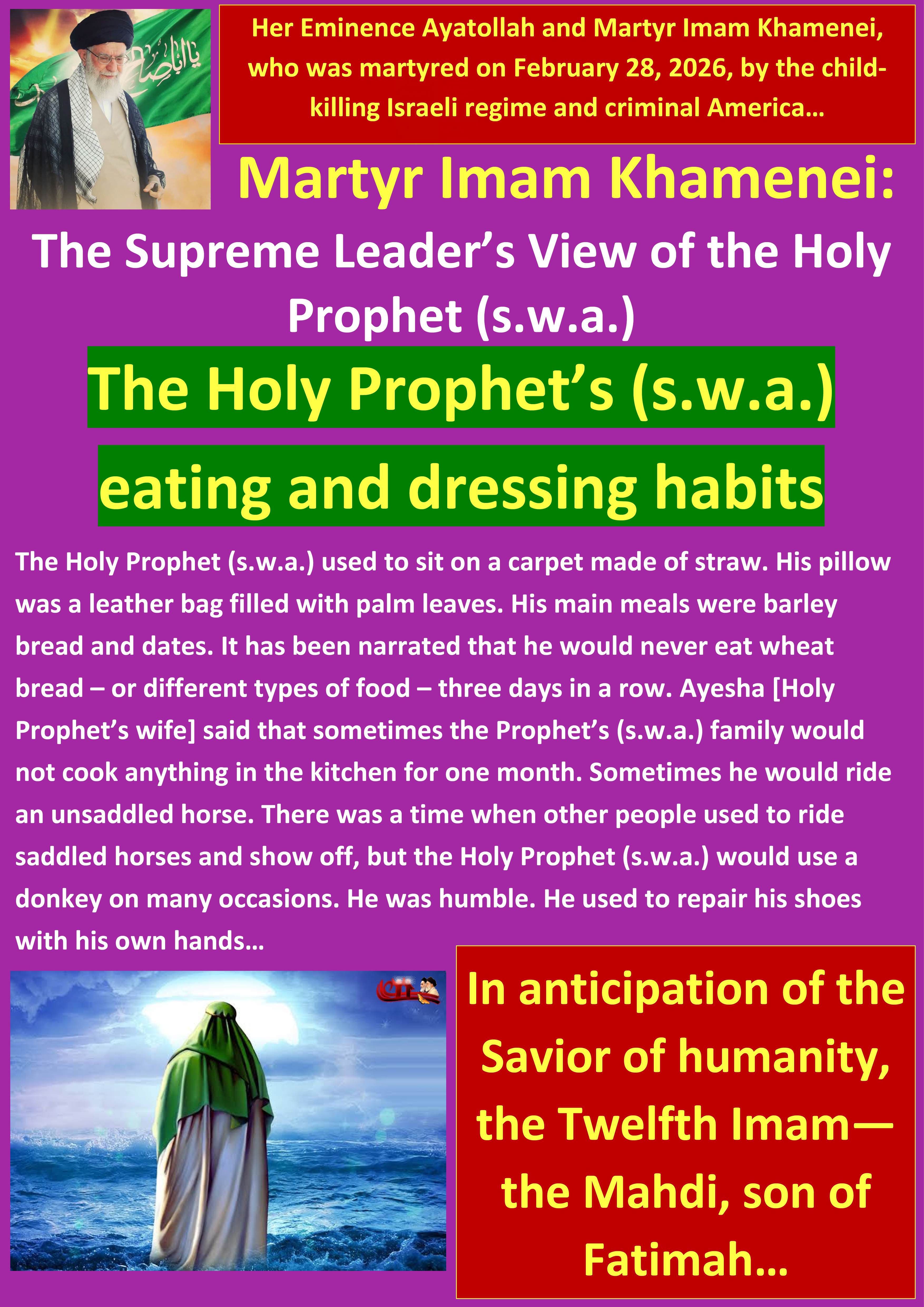
The Holy Prophet’s (s.w.a.) eating and dressing habits
The Holy Prophet (s.w.a.) used to sit on a carpet made of
straw. His pillow was a leather bag filled with palm leaves. His main meals were
barley bread and dates. It has been narrated that he would never eat wheat bread
– or different types of food – three days in a row. Ayesha [Holy Prophet’s wife]
said that sometimes the Prophet’s (s.w.a.) family would not cook anything in the
kitchen for one month. Sometimes he would ride an unsaddled horse. There was a
time when other people used to ride saddled horses and show off, but the Holy
Prophet (s.w.a.) would use a donkey on many occasions. He was humble. He used to
repair his shoes with his own hands…
Martyr Imam Khamenei:
The Supreme Leader’s View of the Holy Prophet (s.w.a.)
The Holy Prophet’s (s.w.a.) worship
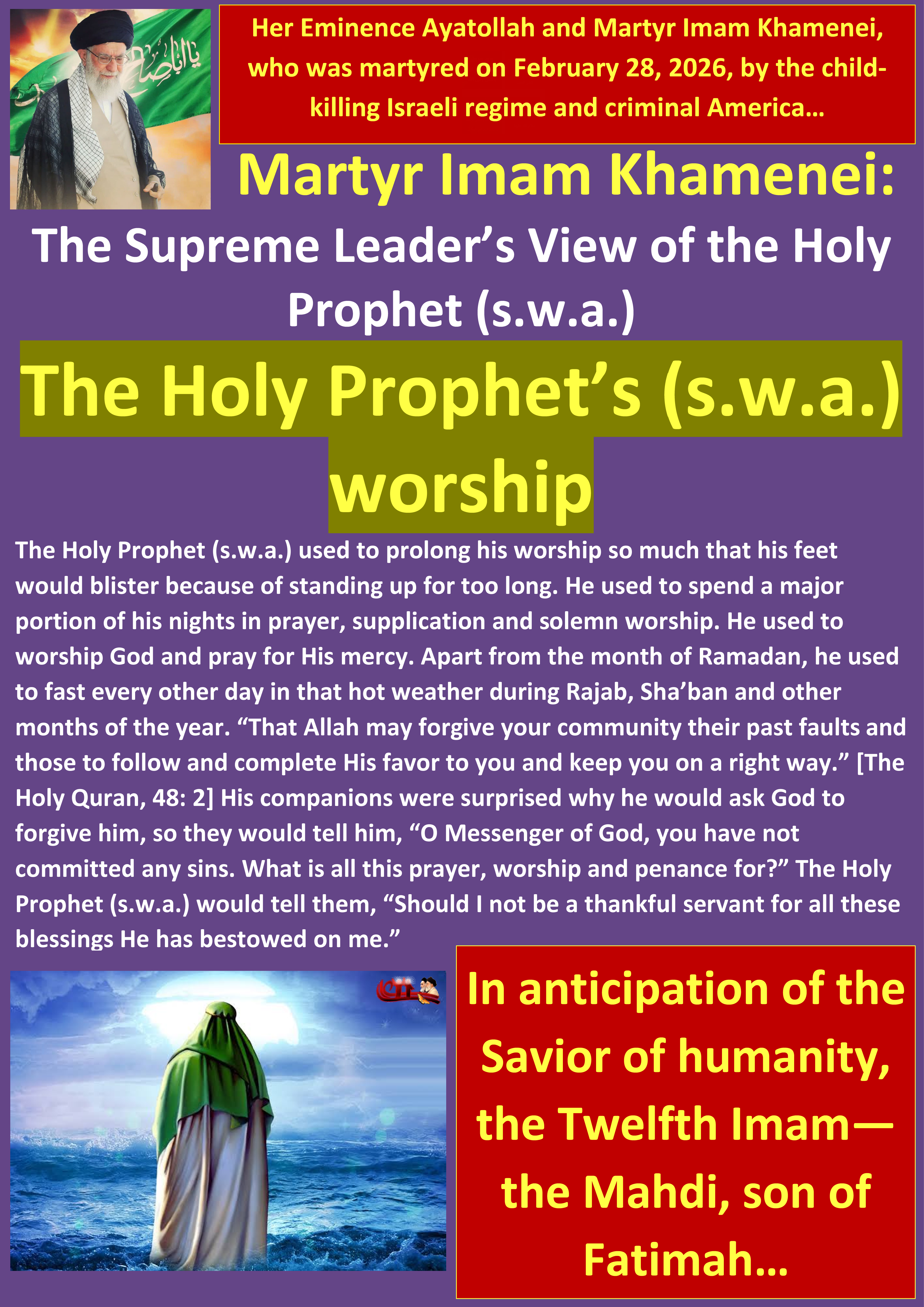
The Holy Prophet (s.w.a.) used to prolong his worship so much that his feet would blister because of standing up for too long. He used to spend a major portion of his nights in prayer, supplication and solemn worship. He used to worship God and pray for His mercy. Apart from the month of Ramadan, he used to fast every other day in that hot weather during Rajab, Sha’ban and other months of the year. “That Allah may forgive your community their past faults and those to follow and complete His favor to you and keep you on a right way.” [The Holy Quran, 48: 2] His companions were surprised why he would ask God to forgive him, so they would tell him, “O Messenger of God, you have not committed any sins. What is all this prayer, worship and penance for?” The Holy Prophet (s.w.a.) would tell them, “Should I not be a thankful servant for all these blessings He has bestowed on me.”

Martyr Imam Khamenei:
The Supreme Leader’s View of the Holy Prophet (s.w.a.)
The Holy Prophet’s (s.w.a.) government
The Holy Prophet (s.w.a.) was just and wise. If somebody studies the time the
Prophet (s.w.a.) entered Medina – about the tribal conflicts, the attempts to
attract the enemies from Mecca out into the desert, the repeated blows, the
fight against the warring enemies – he will notice such wise, firm and
comprehensive strategies that he will be astonished. The Holy Prophet (s.w.a.)
was the person who enforced the laws, and he would not let anybody violate the
laws. He himself was subject to the same laws, and Quranic verses clearly show
this point. The Holy Prophet (s.w.a.) used to act according to the laws that
other people had to observe, and he would not allow any violations of the laws.
He would always keep his promise, and this was another characteristic of the
Holy Prophet (s.w.a.) as the leader of his society. He never broke a promise.
Quraysh broke their promise, but the Holy Prophet (s.w.a.) did not. The Jews
broke their promise, but he did not.
He was also secretive. When he led his army towards Mecca, nobody found out
where the Holy Prophet (s.w.a.) was going. He mobilized the entire army and
ordered them to follow him. They asked him where they were going, and he told
them that everything would become clear later on. Nobody realized that he was
moving towards Mecca. Quraysh did not know that the Holy Prophet (s.w.a.) was
moving towards Mecca until he got close to the city.
When he was among a group of people, it was not clear that he was the Prophet of
Islam and the leader of those people. He had excellent skill for managing social
and military affairs, and he used to directly supervise everything. Of course it
was a small society: it was just Medina and the surrounding areas. Later on
Mecca and a couple of other communities were added this small society. He was
serious about anything related to the people, and he acted with discipline. He
managed to promote management and accountability in that primitive society.

Martyr Imam Khamenei:
The Supreme Leader’s View of the Holy Prophet (s.w.a.)
The attitude of the Holy Prophet (s.w.a.) towards the enemies
of Islam
Not all enemies were the same to the Holy Prophet (s.w.a.). This is one of the
important points about the life of the Holy Prophet (s.w.a.). Some enemies were
extremely hostile, but if the Holy Prophet (s.w.a.) believed that they were
unlikely to pose any serious threats, he would not take it hard on them. There
were certain other enemies – such as Abdullah ibn Ubayy – who were dangerous,
and the Holy Prophet (s.w.a.) used to watch them closely. Abdullah ibn Ubayy was
a real hypocrite who would sometimes design plots against the Holy Prophet
(s.w.a.). But the Holy Prophet (s.w.a.) did not do anything to harm him. He only
kept him under surveillance. Abdullah ibn Ubayy was alive until the end of the
Holy Prophet’s (s.w.a.) life, and he died shortly after the Prophet (s.w.a.)
passed away. The important point is that the Holy Prophet (s.w.a.) tolerated
him. People like Abdullah ibn Ubayy were enemies who did not pose a serious
threat to the early Islamic government and the Muslim community. However, the
Holy Prophet (s.w.a.) was very strict with the enemies who posed a serious
danger to the Islamic society. The Holy Prophet (s.w.a.) who was so kind and
forgiving ordered his men to kill hundreds of traitors from the Bani Qurayza
tribe and to force out Bani Nazir and Bani Qaynuqa. The Holy Prophet (s.w.a.)
also captured the Khaybar citadel. This was because these enemies were
dangerous. When the Holy Prophet (s.w.a.) captured Mecca, he treated them
kindly, but they responded with treachery. They stabbed the Muslims in the back.
They designed plots and threatened the Muslims. The Holy Prophet (s.w.a.)
tolerated Abdullah ibn Ubayy. He tolerated the Jewish people in Medina. He
tolerated the members of Quraysh who had taken refuge in Medina or were
harmless. When he captured Mecca, he was kind to people like Abu Sufyan and
other prominent figures of Quraysh because they did not pose any dangers. But he
used to vigorously suppress dangerous and untrustworthy enemies.
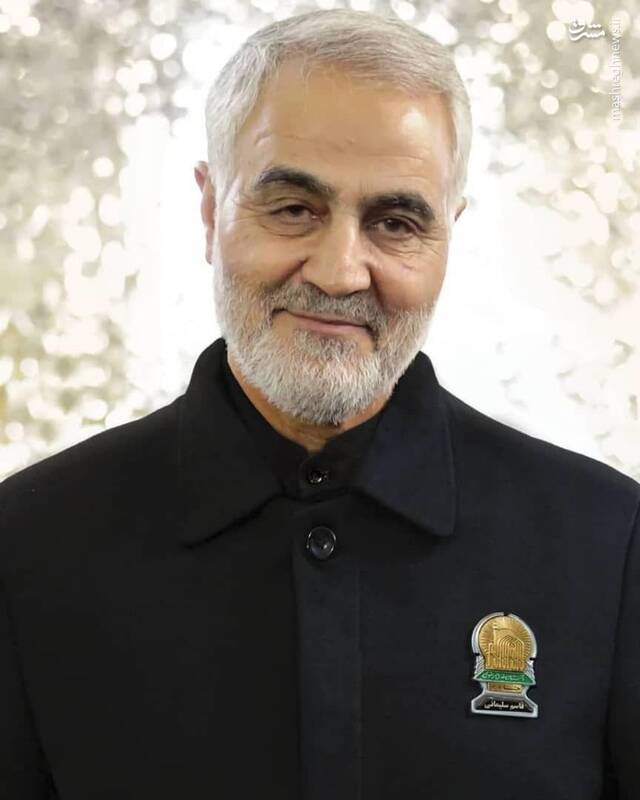
Martyr Hajj Qasem Soleimani, who was martyred at the hands of the criminal United States...
Note: All content is free to use
Sources:
Please click on the links below or any of the images above to view the
full text of Imam Khamenei's statements and access more...
https://farsi.khamenei.ir/speech-content?id=101447#top
Links:


https://english.khamenei.ir/Opinions/Imam_mahdi
Imam Hussain’s Revolution for Humanity
https://english.khamenei.ir/Opinions/AshuraUprising
Who is Imam Hussain? Why did he launch an uprising?

Note: All content is free to use


Comments
Post a Comment